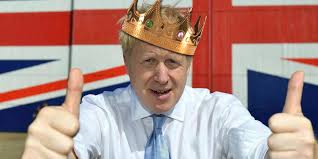
Here in Ireland we are recovering from Lockdown 3, case load is reducing but the hospitals and entire health service is incredibly overloaded. There is real concern that new variants may be more serious, transmissible etc, and not covered by the vaccines.
Yesterday our government announced new travel restrictions, essentially enforcing mandatory quarantine for arrivals into the country arriving from certain countries, or travellers without a negative PCR test. But there is an outcry from all sides; too little, too late; not sufficiently detailed etc etc. And it’s true it will take time consuming legislation. And various stakeholders such as the Garda are indicating monitoring home quarantine just won’t work. Again for legal and health and safety reasons.
Now we all know that politicians in general are mostly not individuals with deep expertise. And they and their civil servants are certainly not experts in responding to crisis situations with new systems and processes. And I’ll bet this is the same in many countries around the world. And we probably all share the same issues. We need to keep our countries open as much as possible to protect supply chains and essential business. But we really need to stop individuals bringing the virus, particularly increasing numbers of variants into the country. Some countries have solved this by mandating quarantine in a government facility. But here in Ireland there are so many legal and health and safety problems that it would probably take months to establish. So here the government has elected for mandatory quarantine, but at the individuals place of residence or a specific address.
My thinking is pretty simple. We can solve the monitoring problem tomorrow! Implement a second arrival form for all airports and ports immediately that gets the individual to give details of their phone, post code where they will isolate, and credit card and signature agreeing to be monitored and accepting a charge (of whatever the penalty is) if they move beyond the postcode. The government needs to get a very rapid agreement with telecom companies to log movements on those phones and a simple process to securely pass the phone numbers to the telcos. This would be a VERY simple system to implement immediately. Given the individuals’ agreement there are no GDPR or civil rights issues involved.
If we can log individuals’ movements by their mobile phone to track missing persons or criminal suspects, and most countries do, there is no reason why the setup could not be implemented literally immediately because the individual would formally accept to be monitored as a condition of entering the country.
Well it’s been one hell of a ride! I remember talking to a good friend and colleague almost exactly four years ago. He lives in the greater DC area and does a lot of government business, so I listened hard. He said, “Don’t worry, our institutions are strong. There are many, many checks and balances that stop rogue actors.” And in the last few days I have been mulling over those words. In the end he was right, but you have to conclude that if a rogue president appoints rogue actors at all levels of government, as officials and judges the system only works if those actors have greater integrity than the president. And thankfully in key situations they did.
In the end the judiciary came through. The Supreme and other courts, notwithstanding having been stuffed with Trump appointees, held the line of truth vs wild conspiracy. Like many, I listened to the phone call between Trump and his mad cronies and Brad Raffensperger, Georgia’s secretary of state with amazement. Astonishment that Trump was so ignorant, unprepared, unable to talk detail. Awe that Raffensperger simply held the line of truth and integrity calmly and quietly without bending one inch.
In the end the real problem was the widespread compromise of social media that persuaded a very significant proportion of the electorate that the election had been won fraudulently. As we know it doesn’t take many bad actors to spread lies, and social media inherently reinforces confirmation bias. Conspiracy theories are widespread and if individuals get most of their information via ungoverned tv and social media, plus the president of the USA also provides powerful confirmation, then wild ideas will become de facto truth. Doesn’t matter what the officials, courts or the real subject matter experts say, if all your contacts believe the world is flat, well that’s it. And of course, it’s not just the USA that has been infected with this disease, it’s also in many other countries also.
So, while we can breathe a sigh of relief that the USA is returning to some basic level of sanity, we know the country is still completely divided and holds fundamentally different belief systems. That’s what happens if you put a rogue actor in a position of power.
I have written about the question of social media governance on numerous occasions over the years. While we have seen “self-governance” from Twitter and Facebook based on breach of corporate Terms and Conditions such as incitement to violence or worse, this is clearly not a good or long-term solution. I reiterate the need for a governance and standards body that guides and adjudicates on all aspects of social media services. I recommend we go back to basics; we don’t unleash drugs or automobiles, financial services or other consumer products and services onto the public without trials and regulatory controls in place. Yet over the past couple of decades we have all participated in an enormous social experiment which has had huge impact on many aspects of society, not least the integrity of our democracies. It’s time to ask legislators, social scientists, and technology experts to advise on how we govern both existing and new products and services.
Coda: I stopped using Twitter in 2016. Apart from its most infamous user I couldn’t stand the inherently rude, bullying and trivializing nature of the platform. I don’t intend to return, I can live without it. I believe the world will be a better place if the most powerful person on the planet is not capturing the attention of the world on a minute by minute basis.
This morning I listened to a radio clip about the Irish peat industry. Peat harvested from local bogs has been used for centuries for cooking and heating in Ireland. Throughout the 20th century, peat was prized as a source of rural employment and an alternative fuel for heating and electricity generation during disruptions to coal supply in World War I and II. Peat harvesting was viewed as a patriotic endeavour. A way of life rather than a commercial project.
But given well known environmental issues with peat burning, the end down of the peat industry was accelerated last year and the two peat burning power stations shut down at the end of 2020 saving at least 1.25 million tonnes of carbon each year. For the past 80 years the industry has been a major employer in the midlands. Now there is a major effort to rewild the peat bogs and create new forms of environmentally friendly employment and industry. This closure has been a long drawn out, highly emotive process for the entire midland’s community, but it was always inevitable.
The Irish Agriculture industry is in a somewhat similar situation. Whilst the industry accounts for a relatively small (less than 2% and declining) proportion of GDP, it is responsible for over 30% of all Ireland’s greenhouse gas emissions and unacceptably high levels of pollution. The industry is of course at the heart of Irish country life. It employs some 110,000 people and is central to local communities countrywide. Whilst closure is not even remotely considered, the agriculture industry will need to accept a similarly dramatic level of change over the next 30 years.
The Department of Agriculture, Food and the Marine published a Roadmap towards Climate Neutrality in December. Responding to the report in the Irish Times, sustainability analyst Dr Hannah Daly of UCC commented, “Cows emit methane, a potent greenhouse gas with a very strong global warming impact. Globally, methane from agriculture and fossil fuels has been responsible for the two-fifths of the 1 degree of global temperature rise that has already taken place as a result of human activities.” She continued, “Ireland is the fourth highest per-capita emitter of methane from agriculture in the world, and emissions are 15 per cent higher since 2011, driven by dairy output and abolition of milk quotas. The roadmap does not even reverse this recent rise in emissions”.
Essentially the report has a vision of “stabilising methane emissions and a significant reduction in fertiliser related nitrous oxide emissions, leading to an absolute reduction in the agricultural greenhouse gas inventory by 2030”. The ICMSA “Irish Creamery Milk Suppliers Association” were scathing about the report saying, “. . . featured page after page of likely new duties, regulations, and costs on farmer primary-producers without even once mentioning the reformation of margins in what he described as “an economically broken and environmentally destructive supply-chain to the consumers”.
The ICMSA have highlighted the biggest problem with Irish agriculture. Ireland exports about 90 per cent of its dairy and beef and half its pig meat. In 2019, dairy exports earned the country €4.9 billion, beef exports were worth €2.24 billion and pig meat exports €514 million. (Irish Times). Essentially, we are exporting cheap meat and dairy and living with the pollution that causes, especially from reactive nitrogen which pollutes water supply, greenhouse gas emissions, ammonia in the air and eutrophication of lakes and rivers. Yet the Irish farmers are not adequately remunerated.
Farm incomes are highly variable and complex. But the average family farm income in 2019 was €23,933 down 24 per cent on the 2017 average of €31,374. The dairy sector does better with an increased milk output, with an average income of €66,570. However, we are all aware that while dairy farmers have significantly increased herd sizes over the past few years, they have also had to invest massively in robotic milking systems, leaving most of them with considerable debt to service.
The Department of Agriculture roadmap for supposedly for the next 30 years is also very inadequate in that a) it assumes there will be a market for its products and b) it assumes productivity and biodiversity will not be impacted by climatic conditions. We all know the weather is changing. Over 15 years ago farmer neighbours explained to me how the changing pattern of prevailing winds (away from South West) caused them huge problems, particularly in timing herd movements or field management activity. Also, the clear shift in rainfall patterns with longer periods of drought followed by short periods of intensive rainfall which respectively require costly irrigation and soil management as rain dilutes nutrients and causes pollution as nitrates are washed into rivers and the sea.
Buried in the Department’s report is reference to organic farming. There is a roadmap action item to increase the current area under organic production to 350,000 hectares by 2030. The total utilised agriculture area in Ireland in 2016 was 4.8m hectares, which suggests the Department are aiming to establish 7% of farming land under organic management. This should be read in context with the EU guidelines of 25% by 2030.
The change to organic farming referred to by the Department doesn’t correlate the action to the other issues to be resolved. Organic farmers all know that the problems faced by most Irish farmers are because of the chemical intensive practices that literally destroy the soil and make use of massive quantities of chemical fertilisers that kill all the micro and macro organisms in the soil, that leaves the crops defenceless against all manner of predators, pests and diseases, and therefore requires that the farmer use chemical pesticides. Organic farming is not a fad for the trendy; it’s a complete system that creates living soil that facilitates and enables healthy crops and animals and produces the highest quality, pollution free products.
We need to stimulate and encourage a conversation about where farming needs to go. This shouldn’t be about keeping as close to the status quo as possible, rather about how to establish genuinely high-quality farming that is inherently pollution free. The big roadmap questions to be asked are:
Why wouldn’t we aim to make Ireland self-sufficient in food?
What model would allow a self-sufficient Ireland to remunerate its farmers properly?
Would incentives for localisation of food supply, (farmers markets, local produce to supermarkets) provide better income to farmers and reduce overall emissions.
What percentage of existing farmland is necessary to support a self-sufficient Ireland?
What proportion of the 4.8m hectares could we rewild? What level of sequestration and emission reduction would this provide?
Why export food? If we had to pay (2050) carbon tax on the export supply chain, would it still be economic?
Why shouldn’t producers be localised as Co-ops? Give control back to farmers?
Should we not limit output to maintain or increase rewilded areas?
As consumers transition away from meat and dairy, and as rainfall and drought periods both increase, how should we plan to evolve our farming systems?
Irish agriculture is at a crossroads. The Department of Agriculture is locked in the past and manifestly cannot see beyond the status quo. If it tinkers around the edges of the existing model the industry will emulate the peat industry, shrink and largely die. However, we do have a great resource in the large number of younger farmers who have excellent qualifications and understanding of the science, in ways their fathers never could. They are more than capable of transitioning to a radically different future. It’s vital that leaders are allowed to emerge that can see a roadmap not just to 2030, but to 2050 and beyond. And the EU is encouraging that radical path.
I couldn’t find a single document! There is a 2015 bill and the 2020 Amendment. So, you must read both at the same time. Sounds a little thing, but these are legal documents and it makes it harder than necessary. I suspect lazy civil servants or deliberate obfuscation. Not a good start.
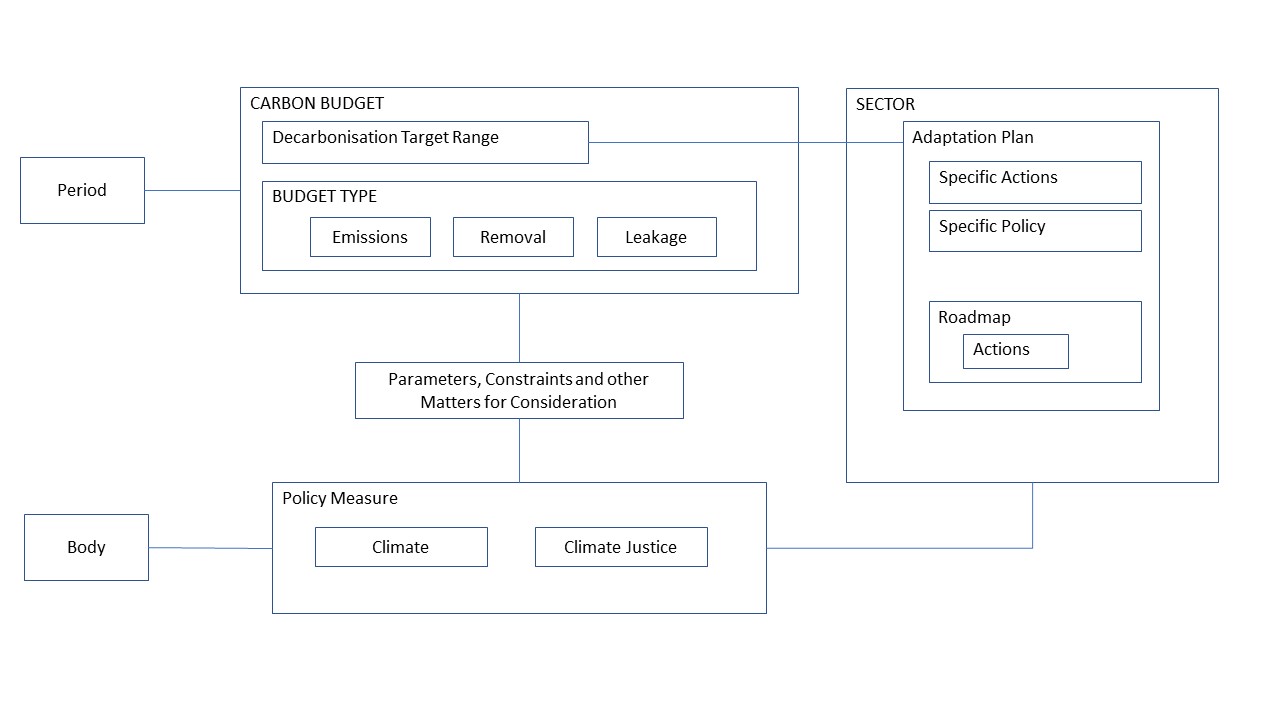
The documents are not designed to communicate, so I started by developing a very simple concept model. It’s self-explanatory.
2. A couple of definitions:
a. “Carbon budget’ means, in relation to one or more greenhouse gases, the total amount of greenhouse gas emissions that are permitted during the budget period.
b. Parameters, Constraints and other Matters for Consideration relate to a catch all requirement for “Minister and the Government shall have regard to the following matters” which is a long list of possible constraints. More on this later.
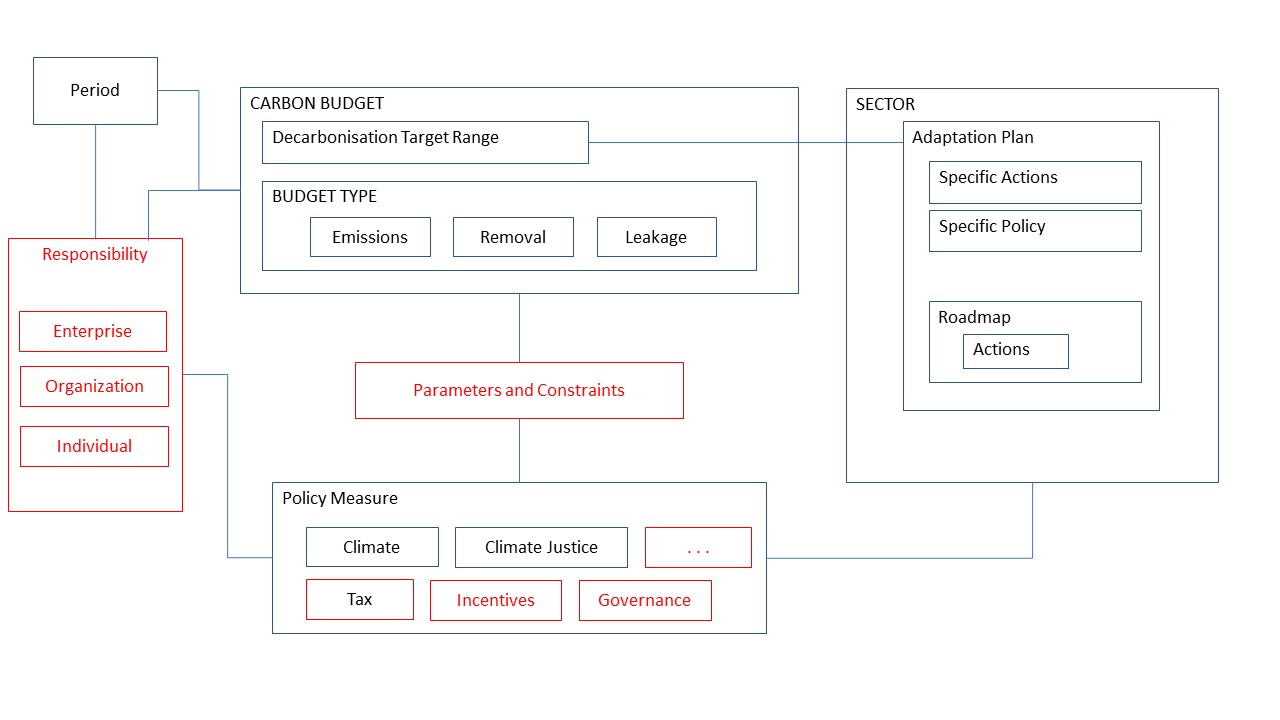
3. When the term budget is mentioned, the first thing I look for is who is responsible. If you don’t have clearly, legally defined responsibility, it is likely the budget will be ignored. In my revised model below, I have added a link between Budget and Responsibility.
So who is responsible for some element of the carbon budget? I suggest making climate improvements needs wide awareness and responsibility which should include state bodies, semi state bodies, commercial and non-profit organizations as well as individuals. Of course, the responsibility and accountability will be highly variable. But we might have policies such as:
a. All enterprises and organizations over €Nm turnover to publish annual update of their Carbon footprint as a web service that can be accessed as public domain information and in annual accounts.
b. Calculated footprints to be published for each taxable business unit by geography and specific consumer products and services. E.g Electricity companies publish total and per Kw by service type.
c. Individuals to be given tools to understand their carbon footprint and made aware of opportunities and incentives to improve.
4. The bill identifies just two types of policy, climate and social justice. It’s notable that the social justice policy type was absent from the 2015 bill, and we can imagine that the Green party now in power had a hand in promoting this important category. But, why not go further and identify critical policy types.
First, the very absence of overall emissions reduction targets is astonishing. Simply stating climate neutral economy by the end of the year 2050 is not helpful. Is this net or gross? What intermediate staging? Targets for every 5 years? Why not emulate Sweden and state 2045? Then there are more detailed policy types. I suggest adding at the very minimum: taxation, incentives, governance, etc
5. Section 3 (3) states, “For the purposes of performing their functions under sections 4, 5 and 6 the Minister and the Government shall have regard to the following matters” which is then followed by a list of what I have modelled as Parameters, Constraints and other Matters for Consideration. If these items are sufficiently important to put into legal text, there should be explicit requirements stated. For example “the special economic and social role of agriculture” is a time bomb that, if left unchanged will potentially compromise implementation of the entire plan.
6. The functions of the Advisory Council are indicative of split responsibility. Lessons might be learnt from NPHET. Also from the UK which has a very strong, independent statutory body. The emphasis of the bill is overwhelmingly about how members are selected and the function of the Council is covered in just a few short lines at the end of a long section.
Revised Model
In summary, very disappointing. I will continue and review some other countries. I note the UK, Sweden and NZ have done good work in this area, and will do some comparisons.
I ordered a new Zoe Iconic R110 50Kw last December. We were extremely lucky to be able to test drive the only new-model car in the country at that time, so we had hands on experience pre ordering. I decided not to wait for the VW ID3 because a) much higher price and b) risk of going with a brand-new model and technology. We were impressed that the Zoe at that stage, was the best-selling EV in Europe. With Covid19, factory closure and all that we eventually picked up the Zoe in early July.
I won’t repeat the generally good comments of all the motoring journalists who have tested the car. It is an exceptionally good car for its size. Fast, very stable and good handling, comfortable, great tech, excellent range. Cheaper than all the competition! We have now done some 4000 Kms and are very familiar with the car and EVs in general. I’ll address the points that journalists doing short tests don’t generally cover or often get wrong!
Normal Range: Most important – the effective range seems to average 350 – 360 in good weather. On longer runs we use Eco mode and you need to get used to it and drive smoothly. Be prepared to kick Eco on and off as necessary. I use the Kw/100 Kms meter a lot – and manage to get the average down below 15 or lower. This allows you to manage the real range and understand how and when to adjust driving style. This might sound a bit geeky, but I can report my wife handles this brilliantly and she’s no geek!
Winter Range: When the temperature is 5 degrees or lower the real range drops drastically. Plan on at least 30% drop.
Reliability: A personal friend gave me a strong recommendation on Renault. He switched to them a couple of years ago and couldn’t be more positive. When we had the car for just a few weeks a driver coming out of a side turning drove straight into the near side of the car. Massive bang! Fortunately, no one was hurt, and the vehicle was driveable. The Renault dealer and engineer were fantastic in response and attention to detail. They took just 3 days to fix the car as good as new. More generally the car doesn’t leak in the rain and is very solid.
Usage: The car is a super mini – it has excellent front seat space. The rear seats would be for occasional use or children only. However, the boot is excellent – it is deep and easily accessed. I often keep the back seats down and that space is very usable for larger loads.
Gear shift: Several journalists have criticised the gear shift. Specifically, they dislike the D (drive) B (Recovery) toggle feature. I can understand if someone is just driving the car for a few hours they might not even realise it’s a toggle operation. In real usage it’s easy to use and highly effective.
Technology: I was worried about the VW ID3 because there were reports that software engineering was a big problem. That’s no surprise – the EV tech is considerably more complex than your fossil fuelled vehicle (FFV) including battery and range management, program setting etc. I will admit it took a few days to get it all on board, but the Zoe tech works, mostly. I don’t use programmed charging as I don’t need it at present, but the app and car integrate very well indeed. At one stage the app gave up and froze. I simply deleted the app and reinstalled. No problem.
Carbon footprint: I had been concerned about the full life cycle carbon load because of the high (carbon) cost of battery materials and production compared to FFVs. However I understand Renault is actively managing the battery recycling process, not just for rental batteries.
Running cost: I charge from a home charger which is the most economic. Basically the normal household rate of €0.17 per Kw (corrected from original text). I have monitored the metered charging process and it’s unsurprisingly totally predictable cost. I haven’t triggered off peak charging as I now have a smart meter installed and the ESB have announced there will be new plans early in 2021 that take advantage of the smart meter capabilities. I have signed up with ESB Connect and it works just fine. I am also registered with EasyGo that is a very useful directory (at least in Ireland) of charging points and critically their status and availability. I don’t yet have servicing costs, but the Renault engineer indicated 12 month check costs are very low (think around €100) because of low number of moving parts.
General comments: Range anxiety does go away very quickly when you have the data. It’s similar to managing gas (diesel/petrol) but different. So, you need different numbers in your head – Kw/100 litre, and forecast range. Having a home charger is really important if you have the space and parking proximity. I normally charge when I get to 110Kms remaining range and charge to 80%, unless we have a longer journey the following day, in which case I will charge to 100%. But this is very much the exception. Covid19 notwithstanding we are doing early thinking about holidays, meeting up with the family on the continent, and will happily take the ferry (to keep the carbon load down) and drive across Europe. With good planning, the Zoe will handle that happily.
In my blog, Happy XMAS (War is Over?) I discussed how the pandemic knocked the air out of all other priorities, and the pressing need now to reprioritize specifically climate change as the really big impending catastrophe. And I posed the question, “Should we simply return to what was normal in 2019? Or do we have a one-time opportunity to leverage not just the accidental reduction in emissions, but to learn from our experience of disaster?”
This last year we have all been following the Covid19 numbers – the cases, the R0, the hospitalization and sadly the deaths. I’ve no doubt that we will continue this in 2021, but I suggest we need to focus everyone on a new set of numbers. Specifically, we all need to become very familiar with the Carbon Footprint, our own personal load, our family’s, our business, our country’s etc. Not surprisingly Climate matters have dropped off the agenda. Even if we hadn’t been so preoccupied with Covid19, let’s be honest we have all become bored with Climate Change. It’s been going for so long, there’s nothing new to say and frankly until it arrives, it’s not news. And the interminable international meetings that all result in failure to agree because vested interests won’t act leave us cold. And even when there are huge wildfires, floods or hurricanes, the scientists say as ever, well Climate Change has some level of impact on the severity or frequency, but we can’t be more specific.
So, what’s changed? Firstly, we have all become more sensitized to the idea that our lives are not running on rails. It doesn’t take much to thoroughly wreck our lives, our livelihoods in an instant. Second during lockdowns many of us have been tuned into David Attenborough, whose gentle but persistent demonstrations have shown us how we ourselves are causing the natural world to collapse!
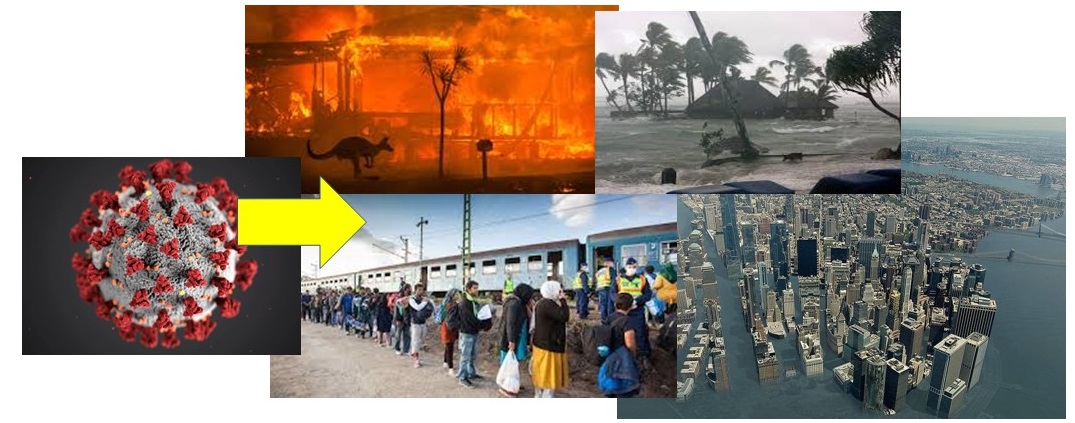
Just stop and consider which type of catastrophe might just arrive into your life without notice – wildfire, flood, drought or absence of potable water, food shortages caused by crop failures caused by all of the others, pollution or unbreathable air, massive increases in migration from affected areas, economic collapse caused by all of the others and so on. Climate change is insidious because it’s happening all the time all around the world and we become desensitized to the news stories. But every day somewhere in the world people like us are being made homeless, sick or dying. You might like to check out the New Humanitarian site on Environment and Disasters.
So, we all need to engage with the new number – Carbon Footprint. We need to use this in our lives to make decisions about whether or how we travel, what we purchase, from where . . . .
Also in my blog post , Happy XMAS (War is Over?) I proposed that we need an app that allows everyone, individuals, businesses, schools, clubs, governments etc to measure their own carbon footprint. The amount of CO2 they are producing on a daily, weekly monthly and yearly basis. It needs to be reasonably accurate; not like the apps you can currently download that are just puerile. The app needs to integrate businesses, government departments and individuals so the performance of my electricity supplier is reflected in my own personal footprint. And we all need to be able to use the app on a daily basis to record and monitor how we are doing.
I would like to see governments getting everyone energized and engaged in Climate actions. For example:
All businesses over €1m turnover to publish annual update of their Carbon footprint as a web service that can be accessed as public domain information and in annual accounts. Calculated footprints to be published for each taxable business unit by geography and specific consumer products. E.g Electricity companies publish total and per Kw by service type.
Governments to establish carbon inspectorates to assess and challenge published footprint data.
Governments to develop sector specific carbon incentives and taxes based on carbon footprint targets and achievements. These could be applicable to businesses and individuals.
In effect I’m proposing that there needs to be both carrot and stick. If we, particularly businesses, but individuals also, reduce our carbon load we should benefit from lower taxes or rebates. And if particularly businesses increase carbon load, we should be taxed more heavily.
The carbon load should also be, excuse the pun, “fully loaded”. In other words, let’s take the example of a meat producer that exports meat products to China, the producer should be responsible for the carbon load incurred by the entire supply chain. In this way we are changing the Climate Agenda – to engage individuals who adapt their spending to reward companies that are reducing their carbon load and enabling individual consumers to do same. And at the same time raising the level of attention and awareness that causes governments to introduce new policies, incentives and taxes to encourage climate friendly behaviour and highlight climate damaging behaviour.
Finally, we should be deeply sceptical about the much heralded COP26 Glasgow Climate Conference, postponed from 2020 to November 2021. Apart from the nauseating sight of Boris Johnson pretending to save the world, we should expect the big countries to agree on some compromise that is a) way too late to stop the world exceeding 2 degrees above pre-industrial levels, and b) allows them to kick the can down the road yet again. We need to energise climate actions in a highly effective way, engaging ordinary people that causes and enables governments to make more courageous longer term decisions.
It’s way too soon to say the pandemic is over, but as we approach the end of the year it’s a good time to think about what’s next. And we all know that while the pandemic has knocked the air out of pretty much all other priorities, the big impending catastrophe hasn’t gone away! I have just finished reading Kim Stanley Robinson’s book The Ministry of the Future. I strongly recommend it. Robinson is primarily a science fiction writer, but this is more of a future scenario strongly based on current climate science.
The book opens in 2025 in India. There is a catastrophic heat wave in which the daytime temperature is at least 38 degrees and 65 per cent humidity. People are dying in their thousands. Boiled, poached or roasted, some 20 million die. This figure is just an estimate because there are no supports possible for the suffering and dying. India is of course very traumatised and there are harsh words spoken about the first worlds’ carbon footprint being responsible for third world disasters. Of course, the whole world is shocked by this event, but as with so many climate events, return to normal happens very swiftly thereafter.
A few years later there is an event that becomes known as Crash Day. Some sixty passenger jets are downed by drone attacks. Thousands of passengers from all over the world die. Several terrorist groups claim responsibility for the attacks, but in the end no clear responsibility is attributed. Again, the world is very shocked, but very quickly gets over the event and continues to fly just as before. Then just a few months later the Crash Day is repeated. And then the message is very clear – do not fly. All types of travellers, businesspeople, tourists etc all stop flying. It has become too dangerous. Airlines fail and airline and airport infrastructure become redundant. There are intermittent, smaller attacks subsequently, sufficient to maintain the pressure.
After this most countries recognize the need to reduce their carbon footprint. Of course, it’s not a straightforward process. The polluting industries keep polluting and use their financial muscle to slow and frustrate transition to sustainable futures. Dark forces are deployed on all sides. Captains of polluting industries become susceptible to sudden and usually fatal accidents. But similarly thought leaders in sustainability are also threatened. But gradually the world changes. And here the book presents a highly realistic picture of how the monetary system is linked to carbon footprint and how central, wholesale and retail banks are brought into the act to change business and individual behaviour. In the end governments have to at least fund the massive infrastructure investment, but it’s the financial world that will reengineer the monetary value of sustainability.
Over the past year we have observed the syndrome whereby we don’t change our behaviour until existential threats are literally unavoidable. The scenes from the Pacific Islands, California, Australia and other parts of the world have been extraordinary. People have lost their livelihoods and their lives. And while we are all hugely sympathetic, it doesn’t really affect us, so we carry on as usual. Of course, the pandemic taught us (well with notable exceptions) that we had to change our behaviour. But now we are seeing the route to the exit, we can all anticipate the rush to return to normal. Everyone is desperate to travel, to see their families, to do business, to go on holiday etc. Similarly, everyone misses their social life in all its forms. But we must ask, should we simply return to what was normal in 2019? Or do we have a one time opportunity to leverage not just the accidental reduction in emissions but to learn from the experience of disaster that literally stopped us in our tracks.
Let’s not forget, climate change will be several orders of magnitude greater impact than the Covid19 pandemic. But the reason we haven’t responded to the climate change threat is because it’s only impacting on a relatively small minority of the global population. But now we have all have the common experience of 2020 and perhaps will be more inclined to be less selfish?
In 2020 we have also observed that governments have been subservient to other disciplines – medical, scientific and public health. And while we all have opinions on the experts, in the main we can’t help but be impressed with their sangfroid in the face of disaster. And that has been a good thing because governments are generally very slow to respond and deal with change. Whereas experts are on their own territory and have at least some of the answers. So, in context with climate change, we shouldn’t expect governments to make the running. They quite simply don’t have the expertise, even to ask for the help they clearly need.
In Robinson’s future scenario he focuses on making change socially, commercial and financially attractive on many levels. And I suggest that to capture the prevailing mood and transfer this smoothly to addressing the climate crisis, we need to do the same. And we need to give “everyone” a mechanism that they can a) see how they are helping and b) how they can benefit.
I suggest we need a mechanism (an app would be good) that allows everyone, individuals, businesses, schools, clubs, governments etc to measure their own carbon footprint. The amount of CO2 they are producing on a daily, weekly monthly and yearly basis. It needs to be reasonably accurate; not like the apps you can currently download that are just puerile. We need to bring AI to bear on this problem. The app needs to integrate businesses, government departments and individuals so the performance of my electricity supplier is reflected in my own personal footprint. And we all need to be able to use the app on a daily basis to record and monitor how we are doing.
The app should also allow us to plan, to understand the carbon load of decisions such as holidays, air travel, purchases of appliances etc. And all around the world we have millions of enthusiastic young people who, until this year were taking Fridays off school to protest about climate inaction. So, here’s an opportunity for these young people to become involved. To be able to engage with their parents, friends, schools etc to understand the science better and to become genuinely part of the worldwide effort.
Governments of course have a major role to play, particularly in creating incentives. Many governments have established grant systems to fund sustainable infrastructure including EVs, chargers, solar panels, heating and insulation systems etc. But governments can go much further, by creating climate transformation plans that guide individuals on decisions that will help them to progressively reduce their carbon load, and to reward individuals for achievements in tax breaks etc. And of course, the app will provide empirical evidence of the individual’s performance.
My scheme outlined here is crucially a bottom up scheme. I would recommend the app is “open sourced” by non-profit enterprises, funded by governments all around the world. We really don’t want to reward yet another technology giant enterprise with this task. Rather this is an opportunity for individual and collaborative creativity, and to encourage tens of thousands of individuals to get involved in this virtual enterprise and show governments what they need to do make progress.
Let me know if you would like to collaborate on specifying this app.
I see today in the Guardian that “The US government and a coalition of 48 states and districts have filed parallel lawsuits against Facebook in a major antitrust offensive that accused the social media behemoth of anticompetitive behavior and could ultimately force its breakup.”
In 2017 I posted “It’s time to exert governance over the the Global Tech Leaders!” In this post I discussed how 20 years ago I and my research colleagues identified the problem with “platform companies” and the likelihood of market domination. In 2017 I said, “All enterprises require some form of governance, internal and external. In the past external governance of corporations has been about ownership, assets and financial probity. More recently there has been some moves to implement more qualitative forms of governance to require corporations to report on issues such as climate change and social responsibility. Clearly, we now need strong governance over the technology companies and their customers use of the platform. I am speaking specifically about Facebook, Twitter and Google as priorities, but I fully anticipate the requirement will be much broader“
Frankly splitting Facebook is insufficient. Particularly if the split just separates out WhatsApp and Instagram. Facebook will continue to dominate the market.
In 2017 I proposed some simple remedies as follows:
a. Establish limits over individuals’ or enterprises’ use of the social platforms. Require named tech companies to make an account charge of $1 per month for every follower/friend over say 1000. b. Require platforms to highlight paid adverts and accounts to other users. c. Require named platforms to provide open standards for interaction between social platforms to reduce monopoly behaviors. d. Require user ownership of personal data and rights to opt in or out of profiling based messaging and advertising. e. Require message privacy to be subject to external governance by approved security services. f. Recommend country level taxation systems that claw back excess profits supplementary to corporate tax regimes. 3. Charter the UN governance board to establish communications with country level governance boards and facilitate coherent implementation of policies at global and country level.
The most important remedy is point c. – to open up not just Facebook, but all social media platforms, to enforce open standards that allow standard approaches to platform interaction. This one remedy will encourage and enable agile competitors to enter the market and be successful by providing both extension and superior capabilities to the core platform(s).
Let’s remember how legal challenges take forever and ultimately fail to achieve the desired objective. Consider United States v. Microsoft Corp – and how the American antitrust law case in which the U.S. government accused Microsoft of illegally maintaining its monopoly position in the PC market primarily through the legal and technical restrictions it put on the abilities of PC manufacturers (OEMs) and users to uninstall Internet Explorer and use other programs such as Netscape and Java. In the end, the DOJ reached an agreement with Microsoft to settle the case. The proposed settlement required Microsoft to share its application programming interfaces with third-party companies and appoint a panel of three people who would have full access to Microsoft’s systems, records, and source code for five years in order to ensure compliance. The states regarded the outcome as just a slap on the wrist.
Those who cannot remember the past are condemned to repeat it! George Santayana-1905.
It seems the Brexit process is likely to founder on the rocks of Sovereignty. Earlier today Boris Johnson said, “the EU was seeking an “automatic right” to retaliate against the UK if its labour and environmental standards diverged from theirs.”
Now it occurred to me to look at how the Canada deal (CETA) with the EU is organized. Some facts: In 2018:
– Canada’s trade in goods with the EU accounted for 10% of its total trade with the world – the EU accounted for approximately 8% (7.62%) of Canada’s total goods exports – Canada accounted for 2% of the EU’s total external goods trade – bilateral trade in goods between the EU and Canada was valued at approximately $90.9 billion In 2018, the most important category of goods traded between Canada and the EU were:
– machinery (25.6% of EU exports to Canada and 24.3% of its imports) – chemical and pharmaceutical products (16.2% of EU exports and 9.1% of its imports) – transport equipment (15.6% of EU exports and 9.1% of its imports)
Looking at the Canadian trade commissioner’s guidance documents makes it clear that regulatory compliance is a big thing. Types of regulation clearly vary across product sectors such as food to chemicals and medical products and medicines. As might be expected there are shipment inspections for foodstuffs. For other product sectors there is European Certification and CE marking where a symbol is affixed to a product by its manufacturer before being placed on the EU market to certify that the product has been assessed and complies with all EU requirements for safety, health and environmental protection.
So here’s the thing. The EU is not demanding that Canadian standards conform to the EU standards. Only that products shipped to the EU are compliant with EU regulatory standards. If they do not comply, they don’t get shipped or accepted. So there is no suggestion that the EU is mandating Canadian internal affairs or interfering in their sovereignty.
Why should the UK be any different? Well of course the UK products are currently compliant – they have already been approved by the regulators. So only new products coming to market need to be certified. So where’s the problem? If the UK decides to lower its standards for chicken, to accommodate US trade, then chicken products are no longer acceptable in the EU. It’s a responsibility upon the UK supplier to obtain recertification when product composition changes, and submit to shipment or periodic or self requested regulatory assessment.
And if UK labour or environmental standards diverge from the EU standards, then the regulatory body should flag the issue and the product no longer ships to the EU. Where’s the problem? If the EU relationship with the UK is the same as with Canada. the EU isn’t trying to change the UK’s standards, merely ensuring that products shipped to the EU are compliant.
Perhaps it’s a matter of trust? Does the UK accept EU regulatory assessment and assessors? But why should the UK relationship with the EU be any different to Canada’s?
A proposal to enable citizens to exert governance over those that abuse the social media platforms.
For the past few decades we have all been part of an enormous, worldwide sociology experiment. And the results are not good. Outside the technology sector many products are subject to regulatory control, primarily for public safety considerations. Think of pharmaceuticals, automotive, medical devices, food products and many more. Similarly, in the high-tech business sector many standards have been developed by collaborations between leading tech firms who have supported the creation of standards organizations such as the OMG, DTMF, W3C, The Open Group and many more. Without these our modern tech-enabled world would simply not work! In contrast the social media tech sector has been like the wild west. While there has been considerable attention to data security and privacy, there has been literally no consideration of the effects of universal availability and abuse of social media on our society.
It was thirty-five years ago when I first observed the syndrome of the keyboard warrior in the business environment. It was quite a shock, when seemingly reliable, intelligent, often senior individuals sent vitriolic or abusive mail messages over the early Internet that were completely out of character. Often the message was an impulsive, angry response to a previous message that frequently resulted in further angry exchanges and face to face arguments. In business environments today keyboard warriors are quite rare. But in the social media environment in general there is much less self-control. Further the perceived anonymity of social media has encouraged widespread distancing from the truth. Many people feel unencumbered by societal norms of truthfulness and over time social media practice has merged with reality.
Over the past few years, we have observed high profile public figures who display utter contempt for truth. As discussed in my last post, no lesser figure than the US President is now a case study for this convention breaking behaviour. And while Donald Trump didn’t invent this behavioural pattern, he has certainly demonstrated a talent for not only using it but encouraging huge numbers of people to believe the unbelievable and for many, many others to follow suit. As I said in my last post, we must now recognize that technology has facilitated this problem and it’s time to fix it.
Inevitably the leading platforms come in for considerable criticism from all sides because of the divisive nature of US politics at present. Facebook and Twitter have implemented some levels of governance themselves, and while most of their efforts have been focused on those publishing abusive images, Twitter to their credit have flagged numerous Trump tweets that are barefaced lies. But this is woefully inadequate.
As discussed the tech companies have been leaders in developing standards. As new technologies mature there is often the pressing need for common approaches. Frequently standards bodies are formed by the tech companies themselves, and often the standards are evolved from existing practices and technologies that have proven effective. And in this area of “truth governance” it would seem that Facebook and Twitter in particular might cooperate to everyone’s advantage.
My proposal is very simple. Every tweet or post should have an additional button labelled TRUE/FALSE. This would be similar to LIKE. Supporting the TRUE/FALSE button an artificial intelligence (AI) engine should monitor, not whether something is true or false, that would be too difficult at this stage, rather monitor the individuals who register the truth status and detect probability on the basis of individuals prior assessments and swarm behavior. This last type of analysis would aim to detect when there were deliberate efforts to coordinate and or misrepresent genuine assessments. On the basis of collective assessments, the platforms should implement a common penalty system along the lines of sports penalties. Yellow card for early warning; red card for serious breach. Behind the scenes a standards body funded by the tech companies should develop the AI truth engine and employ mediators, similar to Wiki Administrators – trusted users with access to certain functions not available to other users, for example the ability to delete pages and block posts and users.
We mustn’t expect all social media platforms to comply with the standards. There are platforms such as Parler that allows users to “speak freely and express yourself openly, without fear of being ‘deplatformed’ for your views”. While we might expect certain users to gravitate over time to lower or ungoverned platforms, the advocates of “free speech” and conspiracy theories will continue to undermine the leading, governed platforms. As AI based governance engines become more sophisticated there will be some migration to ungoverned platforms. We can only hope these will become very niche over time.
During the past over four years we have all become accustomed to lies and fake news from the Trump campaign. Perhaps even Trump himself believed he could manufacture a fantastical conspiracy theory underpinning massive electoral fraud, and use it to annul the election. Yet, apart from the most hypnotized followers in his base, the majority of people will now see Trump as liar in chief. We might play Trump at his own game and colloquially label the TRUE/FALSE button as the “Trump” button, and use the verb “to Trump”. It’s only fitting that we remember him in the right context. The entire social media environment has become like the wild west. Anyone can say anything and see wild ideas and fantastical theories become instantly circulated and believed. And while the US presidential election looks likely to be resolved, there must be widespread disillusionment with democracy. Perhaps the time has come when, after the world has seen to its horror how things can go so wrong, that there’s some willingness to walk back from the cliff edge.